Introduction
Endbugflow software is quickly becoming an essential tool for modern development teams. In today’s fast-paced digital environment, managing workflows and tracking bugs efficiently is no longer optional—it is necessary for success.
As software projects grow more complex, teams often struggle with scattered tools, missed issues, and poor communication. Therefore, relying on outdated systems can slow down progress and reduce overall productivity.
However, with the right solution in place, businesses can streamline operations, improve collaboration, and resolve bugs faster. This is exactly where endbugflow software makes a powerful impact.
In this guide, you will learn how it works, why it matters, and how it can help your team achieve better results in 2026 and beyond.
What Is Endbugflow Software?
To begin with, endbugflow software is an advanced workflow and bug management platform designed to centralize project activities. Instead of using multiple disconnected tools, teams can manage everything within a single system.
Furthermore, it combines task tracking, issue reporting, automation, and collaboration features. As a result, users can easily monitor progress while reducing manual effort.
In addition, the platform provides real-time updates. Therefore, everyone stays aligned, regardless of their role or location.
Why Modern Teams Need It
As technology continues to evolve, project complexity also increases. Consequently, managing tasks without a structured system becomes nearly impossible.
For instance, developers, testers, and managers often rely on separate tools. However, this approach creates communication gaps and delays. On the other hand, a unified system eliminates these issues.
Moreover, without proper bug tracking, critical errors may go unnoticed. Therefore, businesses risk delivering low-quality products.
In contrast, using an integrated platform ensures better organization, faster resolution, and improved efficiency.
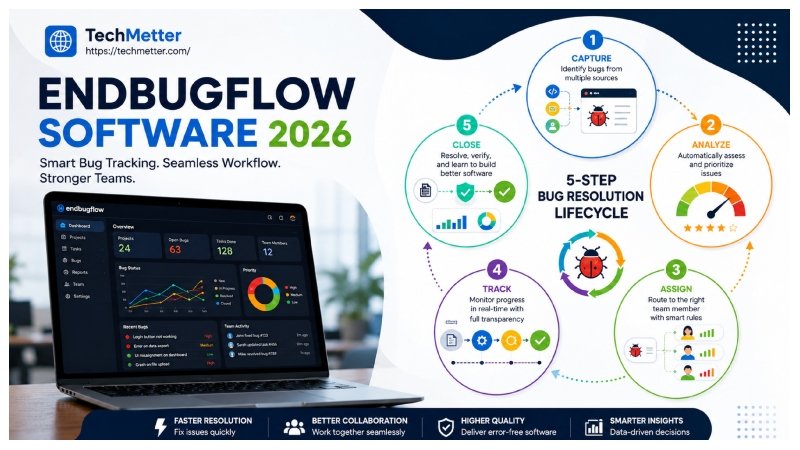
How Endbugflow Software Works
Understanding the workflow is essential. Therefore, let’s break it down step by step.
Issue Detection
Initially, bugs are identified through testing, user feedback, or automated monitoring tools. At the same time, the system collects detailed data such as logs and system behavior.
As a result, developers gain immediate context for each issue.
Categorization and Prioritization
Next, the platform categorizes issues based on severity and urgency. For example, critical bugs are handled first, while minor issues are scheduled later.
Consequently, teams can focus on what matters most.
Task Assignment
After that, tasks are automatically assigned to the right team members. Moreover, workload balancing ensures fair distribution.
Therefore, no team member becomes overwhelmed.
Workflow Execution
Meanwhile, developers work on resolving the issue. During this phase, updates are shared in real time.
In addition, team members can collaborate through comments and shared notes.
Testing and Validation
Once the fix is complete, QA teams verify the results. If the issue persists, it is sent back for revision.
Otherwise, it is marked as resolved.
Step 6: Reporting and Insights
Finally, the system generates reports. These insights help teams identify patterns and improve future performance.
Key Features That Set It Apart
Centralized Dashboard
First of all, a single dashboard provides complete visibility. Therefore, users can track progress without switching tools.
Automation Capabilities
Moreover, automation reduces repetitive tasks. As a result, teams can focus on higher-value work.
Real-Time Collaboration
In addition, built-in communication tools improve teamwork. Consequently, information flows more efficiently.
Advanced Analytics
Furthermore, analytics provide deep insights into performance. Therefore, decision-making becomes data-driven.
Custom Workflows
Lastly, customizable workflows allow flexibility. This means teams can adapt the system to their needs rather than changing their processes.
Benefits of Using Endbugflow Software
Increased Productivity
Because tasks are organized, teams waste less time searching for information. Therefore, overall efficiency improves.
Faster Bug Resolution
Since issues are clearly tracked, they are resolved more quickly. As a result, product quality increases.
Better Communication
Moreover, centralized communication reduces misunderstandings. Consequently, collaboration becomes smoother.
Improved Transparency
At the same time, managers gain full visibility into progress. Therefore, they can make better decisions.
Reduced Operational Costs
In the long run, automation and efficiency lower operational expenses.
Comparison with Traditional Tools
| Feature | Endbugflow Software | Traditional Tools |
|---|---|---|
| Integration | Full | Limited |
| Automation | Advanced | Basic |
| Collaboration | Built-in | External tools |
| Reporting | Detailed | Minimal |
| Efficiency | High | Moderate |
Clearly, modern solutions provide a significant advantage.
Best Use Cases
Development Teams
Developers can track and fix issues efficiently. Therefore, productivity improves.
QA Teams
Testers can document and verify bugs easily. As a result, quality assurance becomes stronger.
Startups
Small teams benefit from an all-in-one solution. Moreover, they save time and resources.
Enterprises
Large organizations can manage complex workflows. Consequently, operations remain consistent across departments.
Best Practices for Maximum Results
To get the most value, teams should follow these strategies:
- First, keep task descriptions clear
- Next, use automation wisely
- Additionally, review reports regularly
- Meanwhile, encourage collaboration
- Finally, update task statuses frequently
By following these steps, teams can achieve better results.
Future Trends
Looking ahead, workflow tools will continue to evolve. For instance, AI-driven automation will become more common.
Moreover, predictive analytics will help identify issues before they occur. As a result, teams can prevent problems instead of reacting to them.
In addition, integrations will become more seamless. Therefore, workflows will be even more efficient.
Conclusion
To sum up, managing workflows and bugs effectively is essential in modern software development. Without the right tools, teams face delays, confusion, and reduced productivity.
However, endbugflow software provides a complete solution. Not only does it simplify processes, but it also enhances collaboration and improves overall performance.
Ultimately, businesses that adopt smarter workflow systems gain a competitive edge. Therefore, investing in the right platform is not just beneficial—it is necessary for long-term success.
Visit Tech Metter for more details.